
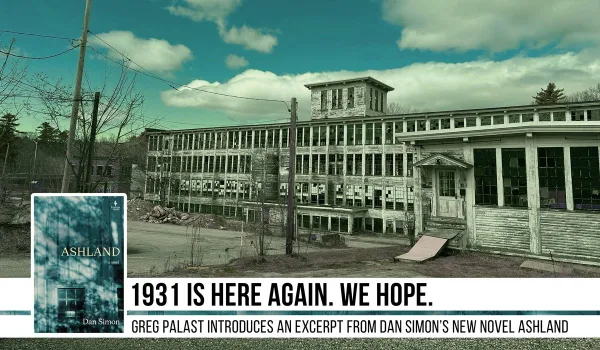
It’s 1931 again. Not 1933, with Hitler still just a cloud no bigger than a man’s hand. In 1931, America was in deep pain. Holding our breath.
Today, we’re holding our breath again. Can we hold it until another FDR leads us out of this darkness? Roosevelt comforted us, rallied us. “We have nothing to fear but fear itself.” Today, our Maximum Leader Kim Jong Trump says he has nothing to SELL us but fear itself.
This first-person account by Gordon—no last name—tells about his time of fear: not a damn bit of work to be had— a young man with his tubercular young wife Edith. He’s wondering if anyone gives a damn.
If, in your news feed today, you don’t hear Gordon’s words, you’re not paying attention. He wrote:
“America has been many things to many people, a place of freedom, and a kind of torture chamber, let’s be honest and say that it’s never been just one thing or the other, that the freedom of some is always paid for by the penury of others. But here is something that is common in both extremes. It’s always a place where you shed what you were to become something new. …There’s no end to the natural richness, and this too mesmerizes people and inspires them with an idea of America as heaven on earth. Eventually, this deteriorates into a severe perversion of itself — American materialism and greed — but there is still somewhere here, or in us, that purer version of a place of great natural beauty and endless possibility.”
But in Ashland, New Hampshire, a lot of people gave a damn. And that’s how Gordon got through it. Ashland is still here. If we choose it.
Gordon doesn’t exist, of course. He’s the creation of the legendary publisher Dan Simon, who’s brought us Gordon and Edith, in a novel, a scrapbook of voices from a little town in New Hampshire that through hunger and disappointment found in the people just down the road that magical thing called hope. I asked Dan if I could reprint this excerpt from this newly released novel. He wrote it in the real Ashland, New Hampshire, and the ambiguity of what is “real,” what is “now,” what is fiction gives Ashland its great power.
And to bring this sense of then versus now versus whatever the hell is in front of us, I asked Dan to take some photos on his iPhone as he left his New England refuge for the cruel counting houses that make up the publishing industry of New York.
– Greg Palast, Los Angeles — March 27, 2026
Ashland by Dan Simon – March 27, 2026

I turn twenty-four in 1931, the worst year of the Great Depression. There’s no work. I paint billboards across New Jersey. A friend of mine has a car, so they hire us. They give us paint brushes and cans of paint. They hardly pay us. We mostly earn our living giving rides to people for a few dollars, whatever they can afford, to bring them from one town to another. We paint the billboards too sometimes. The cash from the riders pays for our gas. It’s not real work. You can’t see yourself in it. Then I sell real estate, for pennies on the dollar. There are few buyers, but people are desperate to sell. These are terrible times. People are going hungry. The looks on their faces, decent people, not understanding, everything almost at a standstill. You learn a lot, and you learn a lot about yourself. I’m not in the game yet. I’m still too young for that. I have nothing to lose, but not much to gain either. You just want to survive. What’s work? It’s passing the time, not work in any meaningful way.
Edie and I are about the same age. I don’t know what she sees in me, unless it’s a reflection of the great admiration I feel towards her from the moment I set eyes on her. We’re two skinny kids in our mid-twenties recovering from illnesses that might have killed us. There aren’t many others our age there. We’re sobered up by what we’ve been through, we both are, meaning we have this sense of the preciousness of what we have that was almost taken from us, not just our health but our entire futures.
* * * * *

I must be frank with you. I’ve said already that people are generally disappointing. We live with a paradise nested deep in our hearts, a place where people treat each other always with great forebearance and kindness and gentility, where adults are respectful towards the young, and where children do not simply respect and fear their elders but also play with them and understand (as children do!) that adults are children too. Always, always. And in our words, well, there are glimpses in our words of the paradise that exists within us. We express our ethics and our morals in words. But our actions are undermined by fear, because the world is a fearful terrain really. Fear is as corrosive as hydrofluoric acid, which I know a little about from working briefly in the oil extraction industry in Texas. Burns through metal and glass, breathing anywhere near it terribly toxic to the human organs. Our fears are real, make no mistake, and there is no such thing in us as fearlessness. But when you mix together our paradise and all too human fear what you get is hypocrisy and betrayal, plain stupidity, all the different human disappointments. If we could only be one of the dumber animals, things would be much easier and most people would be happy with that. Just feed and pet us, slaughter us from time to time if you must, but don’t make us think, don’t make us responsible for anything important. There, I can tell, you must be thinking I’m a misanthrope, and I guess I am. Don’t count on people and you’ll never be disappointed.
* * * * *

But in our case, Edith’s and mine, it isn’t some generalized thing, but rather certain very particular encounters we have with people we trust that hurts the most.
In the sanatorium, in the Adirondack Mountains region near Saranac Lake in upper New York State, we live quite well and remain there for more than half a year together, getting to know each another. The place combines good meals and time outdoors with a healthy lifestyle that’s rigidly enforced. No drinking, no smoking, nothing like that. Our doctors are guessers, innovators yes, but they’re trying things out, and in those years there’s no specific standard of care. Neither antibiotics nor vaccines are well understood yet, though they’re being studied. It’s known since the late 17th century that sometimes men suffering from tuberculosis improve after their lungs are pierced by swords in duels or in war, so there are also surgical treatments that are being tried. Our doctors decide to remove one of Edith’s lungs, and we have no choice but to trust them. It’s a terrible thing for her to have to go through. I feel they’re playing at being Gods, our doctors, all while mostly being nothing more than fools in white coats. I hate them. And I think they mostly leave me alone because, like them, I’m a man and also perhaps because they realize I’m on to them. But I’m not able to stop them from doing what they did to Edith, and perhaps it saves her, I don’t know. It may well have. Her case is worse than mine.
* * * * *

America has been many things to many people, a place of freedom, and a kind of torture chamber, let’s be honest and say that it’s never been just one thing or the other, that the freedom of some is always paid for by the penury of others. But here is something that is common in both extremes. It’s always a place where you shed what you were to become something new. No longer Polish you’re Polish American, no longer African you’re African American. And it’s a place of an almost grotesque plenitude. Remember that many people who arrive on these shores have seen starvation, or plague, drought, religious wars and wars of conquest. Here they find a sprawling continent of Indian nations and an extraordinary bounteousness, like none could have imagined possible — flocks of passenger pigeons in the millions and tens of millions, that are easy to kill and good to eat; in the West bison herds that cover tens of thousands of acres, in the north caribou populations equally unending. Salmon populations in the West and the East. There’s no end to the natural richness, and this too mesmerizes people and inspires them with an idea of America as heaven on earth. Eventually, this deteriorates into a severe perversion of itself — American materialism and greed — but there is still somewhere here, or in us, that purer version of a place of great natural beauty and endless possibility.


Dan Simon is the founder and editor-in-chief of Seven Stories Press.
Ashland is his debut novel, available on Amazon, Bookshop.org, and independent bookstores across the nation.
He lives in New York and New Hampshire.
Photos: Northeastern New Hampshire along Route 25 and Route 3, Saturday morning, March 21, 2026. © Dan Simon, 2026.